
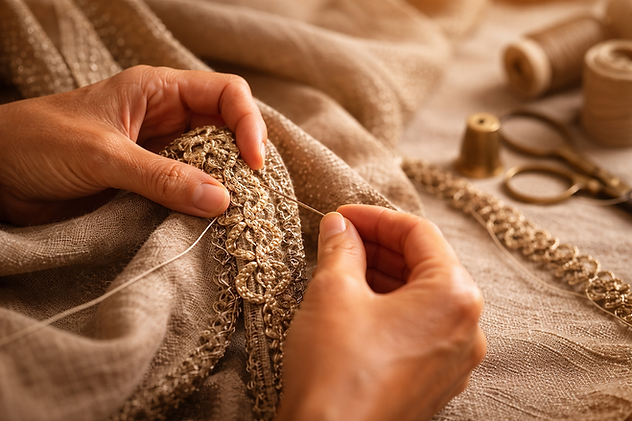
Craft
For Guardisse, craft is not an aesthetic layer.
It is the foundation of how something is made — and why.
Materials are chosen for how they look,
how they wear, move, and endure.

Craft as Intention
Craft begins with purpose.
Before form, before detail, before finish,
we ask how an object will be used, adjusted, and lived with.
Proportion, balance, construction, and finish come first.
Decoration is added only when it serves the whole.
Nothing is added to stand out.
Everything is built to last.

Place as Influence
Place shapes how craft takes form.
Landscape informs weight and structure.
Climate informs materal choice and durability,
Light informs color.
Movement informs form.
Some chapters are guided by the natural world —
by earth, terrain, and horizon.
Others are shaped by places where making remains part of daily life,
where objects are created to serve, not impress.
Tradition & Cultural Intelligence
We approach traditional and regional handcraft as systems of knowledge.
These techniques were developed to solve real problems —
comfort, flexibility, endurance, and function.
Passed through generations, they carry understanding of:
how materials should be handled,
how structure supports movement, and
how objects endure repeated use.

We approach these traditions with respect—
honoring the knowledge they carry while expressing it in new ways.
Color, Material, Restraint
Color is guided by place.
Natural environments shape palettes through repetition — mineral tones, sun-worn surfaces, and the quiet hues of earth and stone.
Craft is not what draws attention first.
It is what earns trust over time.